
RFC NS-B RAG/TAG Meeting 25.03.2026
Meeting of the Advisory Group of Terminal Owners and Managers (TAG) and the Railway Undertaking Advisory Group (RAG)
Read more
Publication of PaP Offer TT2027
Our PaP Offer for Timetable 2027 is now published and accessible via PCS-CB
Read more
CID TT 2026 & CID TT 2027
Corridor Information Document TT 2026 update and Corridor Information Document TT 2027 are now available!
Read more
Rail Freight Corridor North Sea-Baltic – Your East West Rail Bridge across Europe
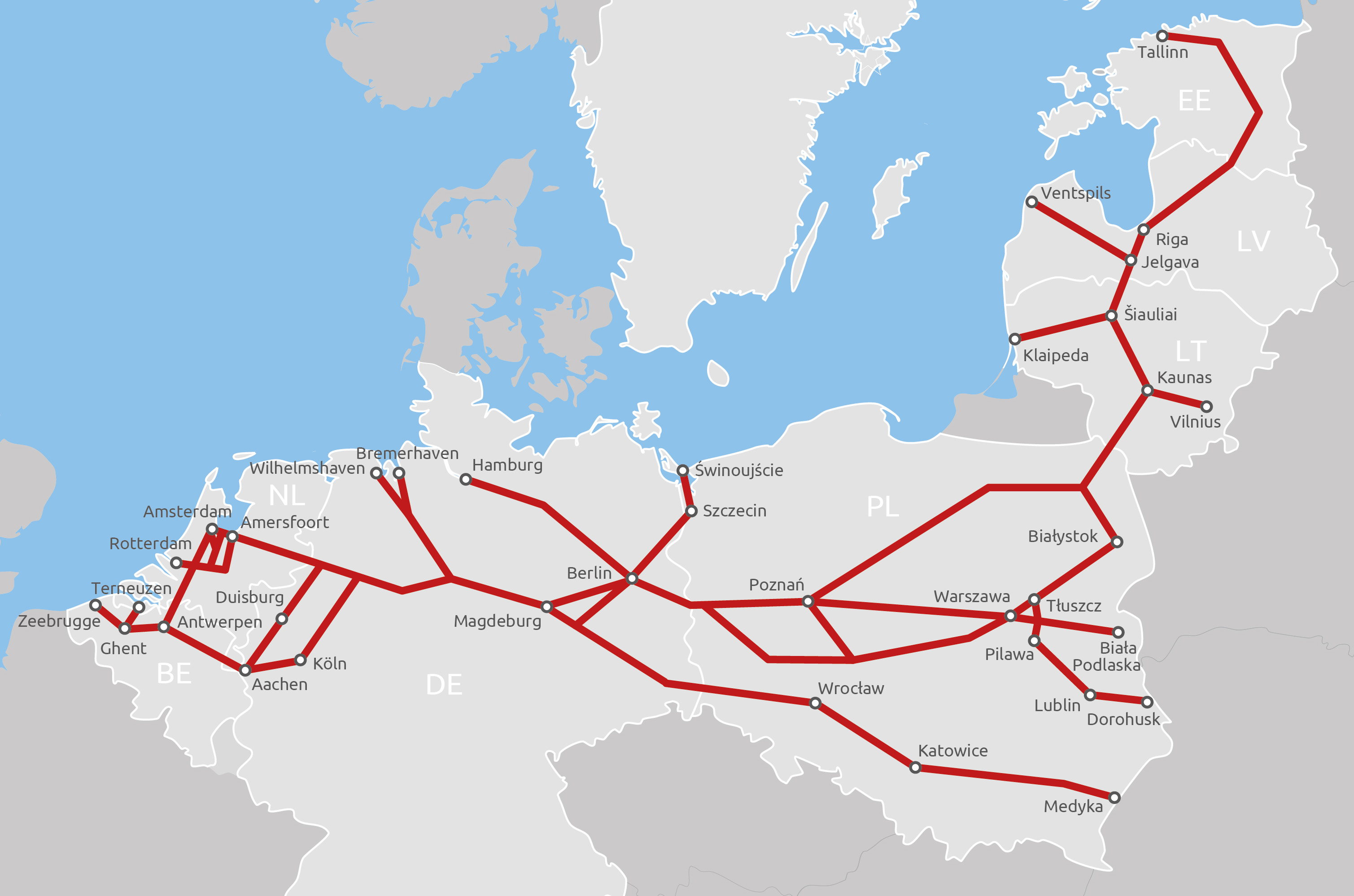
Rail Freight Corridor North Sea – Baltic (RFC NS-B) became operational on the 10th of November 2015 according to Regulation (EU) No 913/2010 of the European Parliament and of the Council of 22 September 2010 concerning a European rail network for competitive freight (hereinafter: the RFC Regulation). Over the years the Corridor was gradually extended to Riga and Tallinn (October 2020) and to Medyka and the ports of Gent/Terneuzen and Zeebrugge in January 2022. In 2024, the Regulation was amended by the revised TEN-T Regulation (EU) 2024/1679 (hereinafter: TEN-T Regulation), that identifies nine European Transport Corridors (ETC). The RFCs are now the freight railway lines of the corresponding ETCs. The map of the RFC is displayed below.
The RFC NS-B passes through seven countries: the Netherlands, Belgium, Germany, Poland, Lithuania, Latvia and Estonia. It stretches from the North Sea ports in Belgium, the Netherlands and Germany to Poland and continues north through Lithuania, Latvia and Estonia. To the South, the corridor extends from Berlin and Warsaw via Lublin to Dorohusk and from Magdeburg via Wrocław to Katowice to Medyka. Eastern branch goes from Warsaw to Kaunas, then to Riga and Tallinn. RFC NS-B includes more than 9000 km of railway lines and connects the most important North Sea ports with Central Europe and the Baltic States providing a rail bridge between Eastern and Western Europe.
Rail Freight Corridor North Sea – Baltic (RFC NS-B) became operational on the 10th of November 2015 according to Regulation (EU) No 913/2010 of the European Parliament and of the Council of 22 September 2010 concerning a European rail network for competitive freight (hereinafter: the RFC Regulation). Over the years the Corridor was gradually extended to Riga and Tallinn (October 2020) and to Medyka and the ports of Gent/Terneuzen and Zeebrugge in January 2022. In 2024, the Regulation was amended by the revised TEN-T Regulation (EU) 2024/1679 (hereinafter: TEN-T Regulation), that identifies nine European Transport Corridors (ETC). The RFCs are now the freight railway lines of the corresponding ETCs. The map of the RFC is displayed below. The RFC NS-B passes through seven countries: the Netherlands, Belgium, Germany, Poland, Lithuania, Latvia and Estonia. It stretches from the North Sea ports in Belgium, the Netherlands and Germany to Poland and continues north through Lithuania, Latvia and Estonia. To the South, the corridor extends from Berlin and Warsaw via Lublin to Dorohusk and from Magdeburg via Wrocław to Katowice to Medyka. Eastern branch goes from Warsaw to Kaunas, then to Riga and Tallinn. RFC NS-B includes more than 9000 km of railway lines and connects the most important North Sea ports with Central Europe and the Baltic States providing a rail bridge between Eastern and Western Europe.